Dispatches From The Mainstream: 1/16/2013

Ludacris feat. Usher & David Guetta – Rest of My Life

Is someone trying to turn Ludacris into Pitbull? Because “Rest of My Life” is basically a remake of “Give Me Everything”—complete with the rallying cry of partying as a life-affirming act—with Usher standing in for Ne-Yo and the original breadwinner for D.T.P. in the place of Mr. Worldwide.

I’m not even complaining, really. Ludacris has enough personality in his voice alone to still be fun in the measly eight-line verses that Pitbull has restricted himself to, and a team-up with Usher is always welcome if just to hear Ludacris call him “Ursher.” A David Guetta-produced “here’s to life”-anthem just seems like an odd fit for a guy who once released an album called Chicken-n-Beer and whose two best songs are about getting into fights for no reason. Then again, one of Luda’s biggest hits was the uncharacteristically dramatic “Runaway Love,” so I guess most people are just looking for a different version of Ludacris than I am.

Whether this song is a case of executive meddling—entirely possible, as Luda’s recent singles have not been charting well—or just an artist exploring his secret love of European dance music, it’s not that bad. There’s a lot of fun to be had in the friction between Luda’s low-brow “Women, Weed and Alcohol”-based persona and D. Guetta’s unabashed pursuit of epic highs . The music video is especially bizarre, since Luda’s videos have historically been a little less “slow motion, emerging from the smoke” and a little more “giant cartoon hands” and “Austin Powers homage”. It’s a fun kind of bizarre, but I hope that Luda’s next single has a little more Luda.

Olly Murs feat. Flo-Rida – Troublemaker

Olly Murs is fine. He made a nice little career for himself in the UK before breaking through in America with “Heart Skips A Beat.” His only crime so far has been inadvertently tricking me into listening to Chiddy Bang. But I don’t want to talk about Olly Murs, I want to talk about Flo-Rida.

I don’t know if Flo-Rida has ever enjoyed rapping. The best things about his songs have always been the beat and the chorus. The chorus usually features a guest artist, but the weird thing is, Flo-Rida sings along with the chorus. He’s been doing it since “Low,” and while that sort of thing isn’t unusual for a singer, it’s kind of weird for a rapper. It’s there, though, if you listen closely: somewhere in the mix of every Flo-Rida chorus is the man himself, drenched in auto-tune and wailing along with whatever pop star/sample he’s built his song around.

Even in what we’ll charitably call Flo-Rida’s “lyrics,” the actual words have always taken a backseat to the rhythm he delivers them in. “Club Can’t Handle Me” is a fantastic song, but Flo’s verses are only good in the way they enhance the beat underneath. Then there are catastrophes like “I Cry,” which veers between condescending and disrespectful. Oh, really, Flo? The mass shooting in Norway made your whole day go sour? That’s rough, buddy. Not to mention the bridge: “When I need a healing, I just look up to the ceiling/I see the sun coming down, I know it’s all better now.” Flo is (probably) trying to tell us that his faith helps him through hard times, but it’s like he doesn’t know quite how to put the words together to form a coherent thought.

And now, in Troublemaker, Flo-Rida abandons rapping entirely. He’s just singing. It’s not as out-of-place as it would be if he featured on a rap song, but it’s still strange that he doesn’t even pretend to do the thing he was hired to do. Thing is, it’s not actually a bad bridge, even if it falls apart on close inspection: Flo, that’s not what Wyclef Jean was talking about when he said he would be gone ‘till November. It turned out better than it would have if he had tried to rap.

At this point, Flo needs to fully commit. He should go full-on 808s And Heartbreak (or, let’s be honest, full-on Rebirth) and just do an album full of straight singing. The vocals may be processed into oblivion, but at least it’ll be catchy… though the lyrics probably won’t make sense.

OneDirection – Little Things

In the morally deficient world of the “pickup artist” there’s this thing called “negging,” which basically means insulting a girl in order to lower her defenses, leaving her vulnerable to your lame, gross advances. The way I understand it, an effective neg has to be part of a longer, less overtly creepy conversation. After all, just walking up to a woman and insulting her isn’t going to get you anywhere; you have to at least say something nice so that she’ll have a reason to keep paying attention to you. Anyway, that’s what I think is happening in the new OneDirection song.

I’ve complained before about the darker side of OneDirection, and I understand that I’m being a little sensitive, but here’s the thing with boy bands: their songs are made to appeal to teenage girls. It’s different from a genre like hip-hop, which is highly problematic and often attracts a young audience, but at least isn’t built from the top-down to appeal to 12-year-olds. When you listen to the lyrics of an OneDirection song, you need to hear them the way a young girl would hear them.

And yeah, I get it: most girls are going to listen to this song and take it the way it was meant to be taken, as a proclamation of devotion in which the smaller, flawed things about a person are part of what make them special. I’m not against that in theory, but some of the things that the song singles out—“You still have to squeeze into your jeans”—seem less like little quirks and more like things that a guy points out to make his target feel self-conscious. Not letting your girlfriend know that she talks in her sleep isn’t cute, it’s actually kind of creepy. The worst part is the bridge. “You’ll never love yourself half as much as I love you”, like the chorus of “What Make You Beautiful”, is only sweet on the surface.  It suggests that if the girl ever gained any self-worth, the guy would split. It’s about 5% adorable and 95% manipulative. In fact, that pretty much sums up the entire band.
The Forty Ounce, Episode 16: … and introducing Merle Dixon as “Ol’ Knife-Hand”

In a sudden but not unreasonable shift away from our podcast’s original theme, me and Daniel have devoted an entire episode of The Forty Ounce to our feelings about The Walking Dead. Because why not, right?

Do you like the Forty Ounce but hate all that talk about music? Do you watch The Walking Dead on AMC? Do you want to hear Jason lose a dollar over a stupid bet? If the answer to any of these questions is ‘yes,’ then this is the episode for you!

In this episode, Jason and Daniel take a break from ranting about pop music to rant about The Walking Dead. Topics discussed range all the way from how bad the show was in Season 2 to how much better Season 3 is than Season 2. Plus, you can find out who Jason and Daniel’s favorite characters are, if you’re into that sort of thing.

Join the Forty Ounce as we discuss the most problematic show on basic cable!

Considering that this is our first episode that has nothing to do with music, I think it came out pretty well. We could probably have been a little more organized, but that’s always going to be a problem for us. The fact that we stuck to even a basic format is a small miracle in itself.

Dispatches From The Mainstream: 12/11/2012

Bruno Mars – “Locked Out Of Heaven”

Sometimes Bruno Mars is not terrible. It used to be, that time only came once a year at the Grammys. Two years in a row, Bruno Mars has taken the stage at the Grammy Awards and performed stylish, retro and totally enjoyable versions of his dull, boring songs. It started with the doo-wop version of “Grenade” from 2011 (complete with all-male back-up singers) and continued in 2012 with a surprisingly rocking version of “Runaway Baby.” Unlike his debut album, Doo-Wops and Hooligans, which featured no doo-wop and very few hooligans, these performances revealed a Bruno Mars who was obsessed with the musical and visual style of eras gone by. I kept waiting for this version of the singer–who I think of as “Good Bruno” or G.B. for short–to emerge in his studio work, but aside from a co-writing credit on Cee-Lo Green’s irresistible “Fuck You,” G.B. was nowhere to be found. When “It Will Rain” was released, I took it as a sign that Bruno had finally succumb to his bland-yet-marketable side, and I mourned the loss of a potentially interesting artist.

If “Locked Out Of Heaven” is any indication, I was wrong to count G.B. out so soon. Bruno Mars finally committed his retro-fixation to record and it resulted in his best song yet. I’m not saying that “Locked Out Of Heaven” could pass for a long-lost Stax record—Mars really belts it on the chorus, but it’s still loaded with modern-day synth—but the verses have an undeniable old-school feel that helps the song stand out without becoming straight-up Fitz & The Tantrums-style pastiche. The funky guitar stabs, the stuttering vocal sample and the rare pop-music bass line that’s actually worth paying attention to all add up to a fun single that will hopefully be a turning point in Bruno’s career.

As for the lyrics, Mars still has a tendency for the dramatic, but considering that he made his name with a song about a woman who was impossibly perfect in every way and another song about a woman who literally dwelled in the realm of the Dark Lord Satan… it’s refreshing to hear him sing unabashedly about the pleasures of sex.

Swedish House Mafia feat. John Martin – “Don’t You Worry Child”

If you’ve listened to the radio any time in the last five years, you may have noticed that we’re living in the era of the ‘club song’. Songs about living in the moment, walking into the club in your best clothes, dancing away your problems… usually set to an electronic beat, these songs are fun in small doses, but more than any other sub-genre of pop song, they’re like candy: too much just makes you feel gross. Personally, my enthusiasm for this kind of song started to wane around the 500th time I heard “Party Rock Anthem.”

It seems like the club song is already on the downward slope to irrelevance. Other trends have taken its place, like the pop-folk of Mumford & Sons, The Lumineers, etc. Even the fist-pumping, synth-laden, pop-influenced EDM sound, the kind of music that seems tailor-made for big, cathartic dance floor moments is becoming uncoupled lyrically from the setting of the club. “We Found Love” by Rihanna and Calvin Harris was one of last year’s biggest hits, and its (somewhat nonsensical) lyrics don’t even hint at partying… unless you interpret the “hopeless place” mentioned in the chorus to be a particularly depressing bar, in which case, I’m sorry.

“Don’t You Worry Child” by Swedish House Mafia and John Martin (who also helped out the band on last year’s “Save The World”) is another example of this trend. The EDM-style beat wouldn’t be out-of-place in a DJ’s playlist or in heavy radio rotation, but the lyrics are about as far from a club song as you could possibly get. Inspired by the beautiful landscapes of Australia, this song features a narrator reflecting on the soothing words of advice his father gave him in his youth. In a musical culture that celebrates youth and glamorizes living in the moment, it’s bizarre–though not unwelcome–to hear a song unabashedly celebrating nostalgia. Where the club song is all about getting you pumped up, this is a song that wants to comfort you while you dance, like a warm hug from a sweaty man wearing a neon-colored headband.

Christina Perri feat. Steve Kazee – “A Thousand Years (Part 2)”

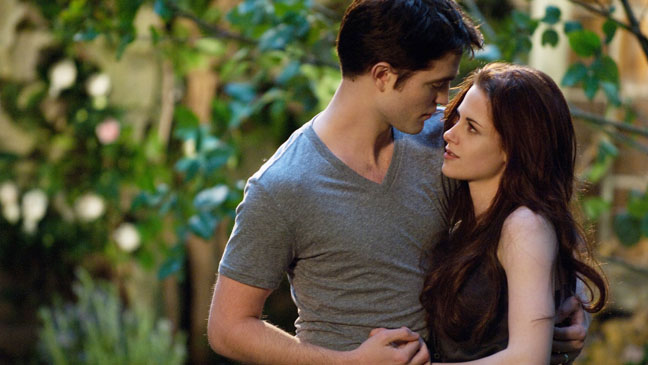
I may have mentioned that I saw the last Twilight film in theaters. One part of the ending I did not spoil is the montage that happens right before the credits, as a result of Bella mind-melding with Edward in order to remind him of their epic love…. or something. For a non-fan of the series, the montage was pretty lame—seeing clips from Edward and Bella’s five-movie love story just serves as a reminder of what a dull, bland trip it’s been—but the song that plays under it goes a long way towards making the scene work.

Yeah, ha-ha, let’s all laugh at Jason because he likes that stupid Christina Perri song from the Twilight soundtrack. You can judge me all you want, but we all know that if a song hits you in the right place and at the right time, it doesn’t matter how mushy and sappy it is. It doesn’t even matter if it’s a song from a terrible movie sung by the woman who wrote “Jar Of Hearts.” Songs like this get made because we all have moments when we’re driving home in the rain and a big, dramatic song comes on, and even though we know it’s just a stupid over-produced pop song, it just gets us and we end up sing-crying all the way back from the Barnes and Noble. I call these moments “Chicago moments” in honor of the band that brought us songs like “You’re The Inspiration” and “I Don’t Wanna Live Without Your Love.”

If you’re familiar with “A Thousand Years” you probably only know the version that played on the radio around the time when Breaking Dawn: Part One came out. But this is not the same version! For one thing, “Part 2” gets a major boost from the vocals of the fabulous Steve Kazee. Kazee is still starring in the Broadway musical Once, and his appearance on this song is a little bizarre, but, hey, if you’re trying to make the leap from Theater Girl Heart-Throb to Normal Person Heart-Throb, I suppose there are worse ways to do it.

Also, the song has been re-recorded and re-arranged in a way that gives the whole thing a lot more texture. The guitars sound like guitars, and the strings actually have some space to breathe instead of just being crammed into the mix. “Part 2” is about thirty seconds longer than the original, so if you’re dead-set against liking this song, it’s just going to feel like the producers were trying to prolong your suffering. But at least give the new version a chance: if a song can actually make the romance of Twilight seem halfway romantic, it’s worthy of acknowledgement, if not outright commendation.

666 Park Avenue, “Hypnos”

“Hypnos” is the first episode of 666 Park Avenue that I’ve watched with other people since I started writing about the show. Like watching a favorite movie in a crowded theater, experiencing something in public that you’re used to experiencing in private can change the way you look at it, or at least offer a new perspective. In this case, I gained some clarity on the show’s many failures when one of my friends asked, “What is this show about?”

I was at a total loss. I ended up saying something like, “There’s an apartment complex that is evil or magic and then the owner of the building is like the devil and then the blonde girl is trying to figure out what is happening.” That was the best I could do, and I spend more time thinking about this show than anyone else in the world.

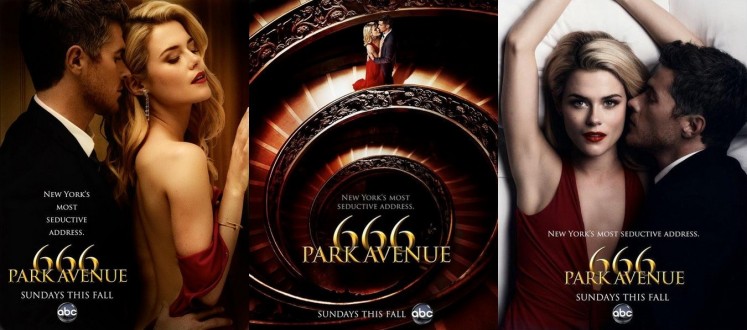
Of course, if ABC’s marketing department can’t convince people to watch this show, I don’t think I even have a chance. It was their job to sell the public on this show, and the best tagline they could come up with is “New York’s Most Seductive Address?”

It's not exactly false advertising, but it is awful.

It’s not exactly false advertising, but it is awful.

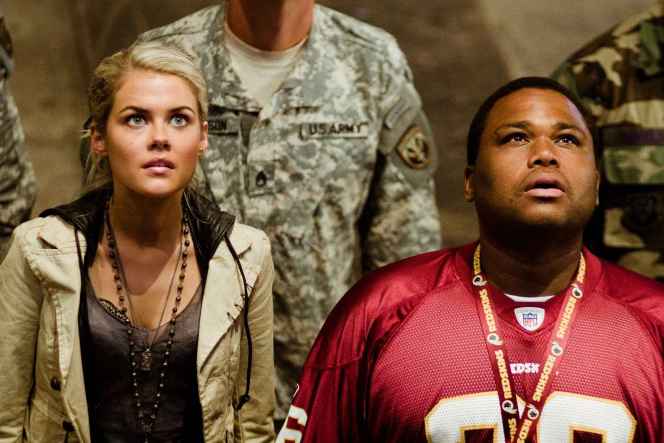
My friend Daniel has already written about the bafflingly inept ad campaign for 666 Park Avenue, but I think it’s worth re-visiting, if only to marvel at the fact that Terry O’Qunn—who I imagine is the reason most people even watched this show to begin with—is completely absent from the poster, and only appeared for a few seconds in the commercials. I guess the network was hoping to promote this show solely on the image of Rachael Taylor, otherwise known as “Anthony Anderson’s friend from Transformers.

Remember this scene? What? No? Well, geez, you don't have to get all defensive about it.

Remember this scene? What? No? Well, geez, you don’t have to get all defensive about it.

In all fairness, it can’t be easy to advertise a show when the show itself doesn’t know what it wants to be. At the beginning of the season, the mystery of 666 Park Avenue excited me. I didn’t know where any of the plotlines were going or even what the show was actually about! Maybe it was naïve of me to see either of those things as a positive. But at this point, with nine episodes of plot development behind us, what the show is about has become apparent. What’s also apparent is that the first four episodes were an almost complete waste of time.

I touched on this last week, so I don’t need to get into it again, but I’m now convinced that episodes two through four were pretty much useless. The creators wasted time with the one-off Damned Of The Week characters and muddled the show’s villain with boring, un-villainous characterization. The parts of those episodes that actually matter (the beginning of the Brian/Alexis/Louise plot, Henry’s rise to political prominence) could have been handled a lot better and a lot quicker.

But let’s give 666 Park Avenue the benefit of the doubt. It’s not unusual for a show with a rocky start to develop into something worthwhile or even great. The ability to refine and adjust a television show is possibly the best thing about the medium, and to the credit of this show’s creators, they seem to be slowly narrowing in on the show they actually want to make, a show full of weird occult stuff symbols that keep demons from entering rooms and trips into the past that leave Shining-style clues as to their reality. Sure, the show still stumbles in the small moments—Jane’s cop friend stripping down to his undershirt for a ridiculous wall-smashing scene—and the big moments—Meris exploding into a flock of white birds after finally leaving The Drake—but the writers are also stumbling towards a show that’s fun to watch, a show that actually has a theme.

Yes! A theme! In this show! In this episode, Meris tells Gavin that “there’s a price to pay for what we want the most,” which is pretty on-the-nose for a show where people make deals with a literal devil. However, this episode added a twist to Henry’s storyline that gives the idea unprecedented depth.

I had assumed that Henry’s “journey to the dark side” (as the creators referred to it) would have him driven away from Jane by a lust for power. This week, though, we see a darker side of Henry himself when he blackmails a potential political ally who tries to exploit Jane’s recent hospital visit. If Henry’s soul is in danger, it’s not because he doesn’t care about Jane, it’s because he cares about her too much. What he wants most is to protect her, and given that he’s currently allied with not one, but two members of the Doran family, Henry might end up paying a high price indeed.

See? Somewhere underneath all the CGI mirrors and magical birds and lines like “I burned your buns” is a show that actually has something to say about the price of success. We’re probably never going to see that show, but isn’t it nice to know that it’s there?

One more thing: after this episode was over, one of my friends asked if “Hypnos” was, by this show’s standards, “a good episode.” I answered, “yes,” and everyone started laughing, which was not a totally unreasonable response.

  • The campaign manager turning out to be the Doran’s missing daughter is a twist I feel like I should have seen coming. Still, I have to congratulate the show whenever it pulls off a twist ending that doesn’t revolve around Jane getting stuck behind something. This reveal actually raises some interesting questions about Sasha’s motives and how she’ll proceed from here. Kudos!
  • “Your family has a dark legacy.” Gee, Meris, ya think?
  • So, Meris is made of white CGI birds, but the Drake is full of black CGI birds. I have no idea what this whole bird fixation is about, but the writers are clearly not going to let it go.
  • I hope the show isn’t building to a face-off between Kandinsky and Tony. Tony’s still my favorite character, and I don’t think I could handle it if he died.
  • The super-depressing 666 Park Avenue Facebook page referred to this episode as the “winter finale,” and there’s no telling when the last four episodes will air, but… uh, see you then, I guess.

666 Park Avenue, “What Ever Happened To Baby Jane?”

Hey, everyone! It’s official!

During that horrible two-week period where we had no new 666 Park Avenue to watch, the show managed to go and get itself cancelled! The announcement was such a foregone conclusion that I don’t have much to say about it. I’m not surprised, because I’ve known this was coming since the second episode aired—except for that brief period of optimism when ABC ordered two more scripts, it’s been all downhill for this show. I’m not sad, either, because while I still find this show interesting, I’m not sure the creators have it in them to turn it into the “compulsively watchable” horror-themed soap I was predicting a few months ago.

One bit of news that I do appreciate: the creators are tweaking the season finale in order to wrap up the entire series. This is great, not because I’m so invested in the show that an unresolved cliffhanger would haunt me for the rest of my life—Twin Peaks this ain’t—but because it means we might get a totally insane logic-goes-out-the-window, gonzo-style ending. Maybe they’ll even go full-tilt Life on Mars and reveal that the entire complex is really just a doll house that Jane owned as a little girl, and Gavin is actually her dad, and he’s really just an insurance salesman, and “Henry” is the name of her favorite doll and… I don’t know, something like that.

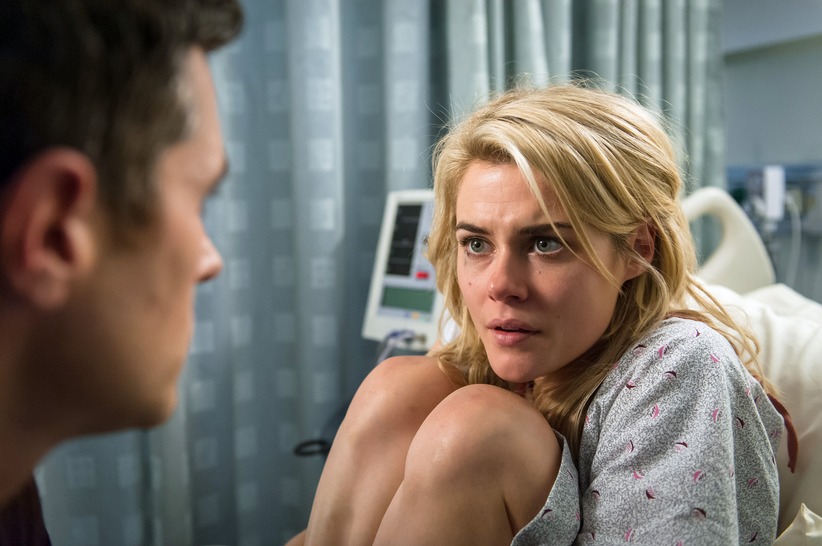
Jane Van Veen, seen here attempting to pull her legs into her own chest.

In the mean time, we’ve got five episodes left of a show that is still showing glimmers of promise now and then. Not only did this episode experience a mild bump in the ratings—which I can only assume is from cancelled-show fetishists like myself—but we got forward movement on all fronts, including the Brian/Louise/Alexis storyline, which is just now starting to show signs of relevance.

In my ongoing attempt to mentally remake this show into something good, Gavin Doran receives a lot of attention. Before the show aired, I read a review that claimed it was a failure because it broadcast Gavin’s villainy so early on. There was no mystery or suspense, this writer claimed, in a show where the audience knew so much more than the main character this early on.

I was resistant to this idea, partially because I wanted the show to be good and partially because, after the pilot, the show really dialed back on Gavin’s villainy. I even said that the show’s semi-sympathetic depiction of Gavin was one of my favorite things about it, because of how it played against our first impression of him.

Well, I was wrong. Once you establish someone as a soul-reaping demon in the first episode, you can’t back off from that. I mean, you can, but it obscures the character and confuses the audience about what kind of show you’re making. Gavin does’t need to be moustache-twirling devil, constantly scheming about how to steal Jane’s soul, but this is the kind of show that needs the villain to be consistently villainous. All of the best Gavin moments either involve him doing something clearly evil—remember when he chopped that dude’s head off?—or interacting with his wife. If Gavin’s character was pared down to those two aspects, he would become a lot more fun to watch without turning into a one-note cartoon.

Gavin has three great scenes in this episode, and they all cast him in a creepy, villainous light. My favorite is the church scene, which is among the best things the show has ever done. Yes, “Sympathy For The Devil” is a beyond-obvious musical cue, and the cover they chose is not the best, but when you’ve got Terry O’Quinn walking menacingly through a cathedral, you don’t need much to make it cool. And to top it off, he has a creepy conversation with the priest about a mysterious demon box! There’s an electricity to this plotline that’s missing from a lot of the show.

Gavin’s scenes leading up to this moment put him back in the mode of demonic crime boss, matching wits with his adversary Victor Shaw. Shaw spends most of the episode tied up in one of The Drake’s many creepy basements, trying to play the Dorans against one another. At one point, he reveals to Gavin that his daughter killed herself and that Olivia knows the truth. Gavin and Olivia move past this pretty quickly—probably due to the show’s sudden insistence on cramming every single plotline into each episode—and Gavin pulls out the big guns: impersonating Victor’s dead father.

Magically disguised as a dead man from until East Germany, Gavin tricks Shaw into giving up the box’s location. It shows how dirty Gavin is willing to play, it gives us some hints about what he’s capable of, and it’s a pretty cool scene, overall… that is, until Gavin dispels the illusion. Before the reveal, there’s a long, lingering shot of Victor’s father staring at the camera, and when I realized what was about to happen, I shouted, “Oh, no, please don’t.”

Sure enough, that terrible, network-grade CGI strikes again, as the old man’s face dissolves into dust, leaving behind a hilariously bad skeleton. It only lasts for about five seconds, but it’s so bad and so unnecessary that it drags the whole scene down. Seriously, guys, you couldn’t think of a better way to do this? Haven’t you ever heard of a cross-fade?

“What do you mean you still can’t get me a role on a good show? You are the worst agent ever.”

Gavin has one last big, villainous moment towards the end of the episode, during a meeting with Alexis. We see a different, more human side of Alexis, as she begs Gavin to release her from one of his trademark bargain. Apparently, she’s seducing Brian under his orders, and she can’t stand what she’s doing to him. Again, this scene is over too quickly, but it gives some shading to Alexis. She’s not just an evil person! She actually has emotions! And Gavin just shrugs it off with an incongruously cheery platitude. His casual disregard of human misery isn’t as over-the-top as a CGI skeleton, but it’s chilling to see someone’s life tossed aside with so little care.

666 Park Avenue was advertised (and probably pitched) as a vehicle for Terry O’Quinn’s peculiar brand of ominous mystery, and I think the show would be better off if it gave him more opportunities to do what he does. I actually like Jane—unlike most of the show’s tiny fandom—but it’s hard to create a compelling protagonist when your antagonist spends half his time worrying about land deals.

In fact, it usually seems like Jane and Gavin are on completely different shows… but it’s possible we might still get a confrontation between the two of them. There are only five episodes left, and according to the executive producers, 666 Park Avenue is building to “powerful and surprising series finale” where all of our question will be answered! Questions like:  “What?” and also “Why?” In fact, the only question that probably won’t get answered is “could this show ever have been successful?”

I’m not sure, but I’ll keep on speculating, all the way through to the end of “Jane and Henry’s incredible journey to the dark side,” and probably well beyond that.


  • Oh, yeah, Jane’s back from her two-day journey below The Drake and she has that kind of amnesia that television characters get when the writers don’t want to reveal something yet. Not a lot of good things to say about her storyline this episode, though I did appreciate the change of scenery.
  • Next week is the long-anticipated (I guess?) appearance of Whoopi Goldberg. I was hoping she would show up at the end of this episode, but getting Goldberg for two episodes is probably way out of the show’s budget.
  • The title this week is a reference to the deeply unsettling 1962 Bette Davis/Joan Crawford movie of the same title. It’s mildly clever, but since this episode actually reveals nothing about Jane’s history, I’m thinking it could have been better deployed somewhere down the line.
  • After next week, I’m not sure what the plan is for the four remaining episodes. I doubt ABC’s wants to drag this into 2013, so I wouldn’t be surprised if we got a “special two-hour finale event” on some dark Saturday in late December.

The Forty Ounce, Episode 15: Another Episode About Pitbull


If you’ve ever listened to The Forty Ounce, me and Daniel’s pop-music podcast, you know about our obsession with Pitbull, a.k.a. Mr. 305 a.k.a Mr. Worldwide. So, it should come as no surprise that we did a podcast celebrating the release of Pitbull’s new album. 

On this episode of the Forty Ounce, the science is in on Global Warming, and we’re not talking about climate change!

Pitbull’s newest album, Global Warming, has been released, and this podcast is the only place you can hear Jason and Daniel experience it for the first time. Having learned nothing from their experience with Rebelution, Jason and Daniel go through all sixteen tracks of the new album! Will they love it? Probably!

This episode is a little messy, because we listened to (nearly) each track for the first time before talking about it. Also, it’s an hour long. Hopefully we still managed to keep things interesting. Hey, at least we’ve got enthusiasm! That has to count for something, right?

I Went To The Late-Night Premiere Of Twilight: Breaking Dawn Part 2 And All I Got Was This Lousy Blog Entry

Thursday, November 15, 2012. Outside, it was a cold and windless night, but inside the theater lobby it was bright, noisy and full of life. People were standing in line for snacks, milling around tables, waiting for friends… some of them were already in line for the movie, tickets in hand.

The crowd was made up mostly of women, from young teenagers to the upper-middle-aged. They were predominately white, but to be fair, I live in a predominately white area, and there were pockets of diversity here and there. But it was almost all women, multiple generations of women and the men they had brought with them. Loving husbands, disinterested boyfriends, I’d wager that nearly every man in that crowd came there at the behest of a woman.

Everyone was talking, laughing, checking their phones, all of them brought together by their love for the tale of a girl and the vampire who loved her.

And then there was me.

I was there alone, at the late-night premiere of The Twilight Saga: Breaking Dawn, Part 2, not part of any group and certainly not accompanying my girlfriend, who wouldn’t be caught dead at something like that. I wasn’t there because I liked the movies (which I had seen) or even the books (which I hadn’t read). I was there for the experience.

I don’t like throwing out broad stereotypes, but it’s fair to say that the Twilight fandom is famous for being full of shrieking girls. In most situations, being in a room full of noisy teens (and the teen-at-heart) is not something I would actively seek out, but this was the premiere of the final Twilight movie. I’ll probably never get another chance to observe the Twilight fandom in real life on this kind of scale. I doubted I would learn anything new, but the novelty of it was too much to pass up.

In a situation like that, it doesn’t matter to me if the thing people are celebrating is objectively bad or, as some have claimed, actively harmful to the impressionable young girls reading it. The joy of people all brought together by their enjoyment of a piece of pop culture is just terrific. The opening night of a popular film is a rare expression of communal excitement. I intended to  be a part of this one, even if it meant going alone.

After a trip to the men’s room (totally empty, by the way), I took my place in line and immediately a question came to mind, a question I have asked many time in my short life: “How much of a weirdo do I look like right now?”

I knew I would stick out. In a crowd of women and devoted men, I was a lone twenty-three-year old male with a shaved head wearing a bulky jacket he wouldn’t take off (I had nowhere to put it!). I’m uncomfortable in any crowd, and if there’s a chance I might attract attention to myself, that discomfort increases exponentially.

But I was prepared for this. I knew that it was unlikely that anyone would actually pull me aside and question my presence, but I still kept a smile on my face and repeatedly checked my phone, as if I was looking for word from a girl who was going to join me… or something like that. I just tried to look busy, to keep a low profile. I had even ordered my tickets online, so I didn’t have to actually say the words, “I would like one adult ticket for Twilight.”

Of course, once I was inside the actual theater, everything was fine, except for the moment when three girls approached my row and asked if anyone was sitting in the seats next to me. I was forced to say “no” and reveal myself for the loser I was.

But I didn’t care. I knew that once the movie started, these girls would be too enraptured by the events onscreen to think about the guy next to them… although, I have to say, I was disappointed with how reserved these fans were. Don’t get me wrong; a chorus of cheers went up during a scene where Taylor Lautner stripped down to his underwear. But I was hoping for a boisterous, obnoxious crowd, squealing whenever anyone kissed and shouting things out at the screen.

And isn’t that always the way? When you want a crowd to shut up—like, say, during the midnight screening of Paranormal Activity 2—they seem intent on ruining your experience, but when you want them to be loud, they can’t be bothered. Gosh, people, am I right?

Despite the obnoxious and uncalled-for maturity displayed by the crowd, I still got a unique perspective on the film (and not just because the girl next to me repeated a mantra of “hot stuff” whenever an attractive male came on-screen). For one thing: did you know there are jokes in those movies? I would never have realized it, if it weren’t for the laughter that sounded whenever Edward cracked one of his signature low-energy, stone-faced wisecracks. There were also a few unintentional laughs, mostly at the hammier aspects of Michael Sheen’s performance. Sheen, by the way, is the only person on-screen during the entire franchise that seems to be enjoying himself.

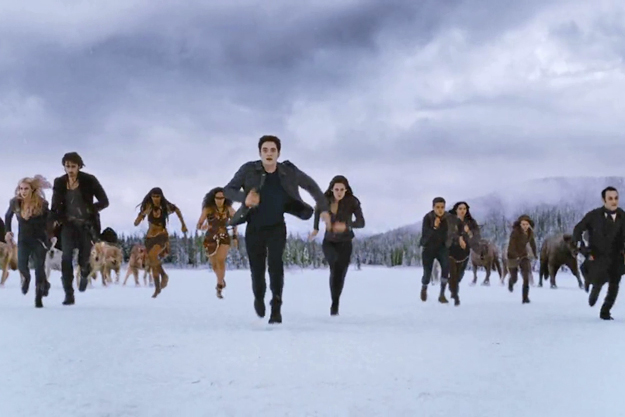
We also had a good laugh at the underwhelming shot of a battlefield towards the movie’s end…. which brings me to the most interesting part of my experience. See, at the film’s climax, Edward and Bella have brought together a group of allies to stand against the Volturi, and–

Oh, I’m about to spoil the end of The Twilight Saga: Breaking Dawn, Part 2, so if you care about that, then… um, stop reading, I guess.

All right: in the books, the set-up for an awesome final battle between our heroes and the evil vampire lords is ditched in favor of everyone talking out their problems and going home. In the film, however, it explodes into a lengthy and fun action sequence, with character deaths all around. Some were tragic, some cathartic: the entire theater gasped when vampire dad Carlisle was beheaded in the early moments of the brawl, and one woman threw up her arms in shock when several other vampires and werewolves were dispatched. A rousing applause swept through the audience when two prominent Volturi were disposed of. It was exciting, it was tense, it raised the stakes for the entire series and had life-changing consequences for everyone involved…

So, of course, it wasn’t real.

After ten minutes of the coolest stuff to happen in the entire franchise, the film cuts back to reveal that the whole sequence was a vision of the future, shown to the Volturi’s leader in hopes of getting him to cool his jets on the whole “killing a child” thing (it works, of course, and Sheen’s understated change of demeanor is actually pretty funny).

Response to this was conflicted, from the moment of the reveal all the way into the post-movie conversation in the parking lot. In the theater, the noisy reaction was audibly split between relief and frustration. People felt a little cheated, which is fair, because they were cheated. But the fans were glad that their beloved characters had not actually died. Several people said that they had wanted to cry during the sequence; some seemed shaken by it even after the credits.

I, for one, loved it—but I knew ahead of time what was about to happen. It was nice to watch the fans react, but it was also neat to see a glimpse of what the Twilight series would be like if it had moved away from the dull romance at its center and explored the more interesting aspects of the mythology… if it had characters take a stand against evil and knowingly face the consequences. You know, like that other big multi-media sensation, the one with the wizards that everyone actually likes.

But my biggest problem with the series has never been the unconvincing, uncomfortable romance between Edward and Bella, or even the whole “sparkly vampire” thing. Plenty of films ask us to find behavior charming that would be terrifying in real life, and if you’re really that upset about the tweaks that the author made to vampire lore, I’m guessing you haven’t enjoyed any horror fiction made in the last hundred years. Just to be clear: vampires aren’t real and any writer can do anything they want with them.

No, my problem is with something that goes mostly unaddressed in the movies, except for a few off-handed comments and a weak series of arguments from both Edward and Jacob. Pretty much from the point she meets Edward, all Bella wants is for him to make her a vampire so they can live together forever in vampiric bliss.

It’s clear that once this happens, Bella can never see her family again, lest they discover that she doesn’t age, and she’ll pretty much have to hide from normal society for the rest of her life. Like the Cullens, she’ll have to move from town to town, never making any real friends outside of the small vampire clan. Oh, not to mention the relentless thirst for blood and the feud she’ll inherit with the family of her friend, Jacob. The series never gives us a convincing reason to look past the inherent horrors of transforming into a vampire. True love is great, but you know what else is great? Not being a monster.

But it’s a little late for complaints like that. The books have all been read, the movies have all been released, and despite some rumblings about the franchise “continuing on” in some form, for the time being, Twilight is over. And all things said, I had a pretty good time watching the last movie… except for this one guy who was sitting towards the front. He had a shaved head, he was wearing this big, bulky jacket, and there was no one around him. I kept waiting for someone to join him, a girlfriend or something, but no one ever showed up. It honestly freaked me out a little and I spent most of the movie side-eying him.

It was just creepy, you know? I mean, what kind of weirdo shows up to these things alone?

666 Park Avenue, “Downward Spiral”

There’s still no word on the future of 666 Park Avenue, but I think we all know how this is going to go. The ratings have dropped by three million since the already-lackluster premiere, an untold amount of the set was destroyed, and now they’re taking two weeks off between episodes? Sure, “Downward Spiral” ends with the most suspenseful cliffhanger of the series, but for a show that people are watching mostly out of habit, this loss of momentum could be disastrous. By the time the ninth episode airs, I might literally be the only person watching, instead of just feeling like I’m the only person watching.

666 Park Avenue is not long for this world. We all know it, and I can’t imagine anyone is all that upset about it. For the purposes of these write-ups, however, the show’s obvious doom is kind of distracting. I know, it’s the reason I started doing these write-ups in the first place, but I’m getting kind of sick of it, aren’t you? I always end up bemoaning the show’s end and not taking the time to figure out why the show isn’t doing so well in the first place.

The easy answer would be that it’s just not that good. Now, I will admit to a certain fondness for the show (though that fondness, like many secondary characters on 666 Park Avenue, comes and goes weekly), but beyond that, I honestly believe what I said when I began these reviews: this show has the potential to be fast-paced, soap-y, creepy, and above all, just plain fun, and if the creators had a little time, I think 666 Park Avenue could be all those things.

Of course, it’s not going to get that time, but I’d like to put that aside for a while. What I want to explore is this: how could this show be better?

First things first: 666 Park Avenue should be moving at a breakneck pace. With a show this silly, you’ve got to keep things going. Just look at Revenge or The Vampire Diaries. TVD especially is well known for burning through plotlines like it was nothing (Homeland also takes this approach, but we’re talking network dramas, here).

666 Park Avenue seemed like it was picking up steam when Jane opened up the ominous locked door in just the second episode… but it turns out all she found behind the door was a creepy suitcase. The creepy suitcase gave us a few potentially interesting turns, but the end result was just to bring Jane back down to the basement and get her to open up a different door.

I can’t say for sure, but I’m guessing that the creators of the show utilizing the slow-drip method of revealing stuff because they’re trying to keep mystery of The Drake shrouded in secrecy as long as possible. I understand why they’re doing this, but it’s unnecessary because the mystery of The Drake is probably the least interesting thing happening right now (next to Alexis and Brian). Maybe the creators just don’t want to shake things up too much this early on, to which I say: really? Really? Is Jane really going to find anything in that staircase that will change the premise of the show?

I guess that when Jane finds out that Gavin is evil (or possessed or the devil or possessed by the devil or whatever) that’s going to be a game-changer… but this show could use a game-changer. Besides, what are the creators afraid will happen once the secret is out? That the show will be all about Gavin working his demonic influence while someone else tries to stop him? Guess what, we already had an episode like that last week. And it was great!

For some reason, I think Gavin’s sunglasses in this scene are hilarious.

Sadly, the Damned of The Week, the part of the show that I used to find so interesting, has turned out to be the biggest waste of time. It seems like it’s not even a thing anymore. And you know what? That’s fine. As cool as it seemed that each episode would have a miniature version of The Twilight Zone tucked away inside of it, I can absolutely live without it.

Except that now, a huge chunk of those early episodes looks like a waste. Why did we need that guy and his dead wife in the pilot? We’d already established that Gavin makes shady supernatural deals with people; we saw it before the opening credits! And that eternally young woman in the second episode who couldn’t stop killing people? What was that all about?

Episodes three and four gave us Annie the Journalist and in turn Kandinsky, who the show is dedicated to keeping around for some reason. But surely there was a better way to get a shady Russian hit man onto the show than by having a guest star get magical powers and then dream him up.

The show has actually improved in this area: the closest thing we’ve had to a Damned of the Week since Annie is Dr. Scott, and he’s been worked into the show so well that his continued presence isn’t totally distracting. And once again, I’m curious about what’s going to happen with him. After his attempted murder of Gavin this episode, I guess that Scott will be out of the picture before long, but honestly? I have no idea.

In fact, I have no idea what’s going to happen in any of the five plotlines that were crammed into the show this week. I still don’t even know what kind of show this is. Is it a mystery about a young girl’s past? A character-driven drama with supernatural overtones? A horror story stuffed with homages to classic films? A soap opera that takes place in a haunted hotel? 666 Park Avenue is none of these shows and yet it is all of these shows.

And even when those shows annoy me—the Brian/Alexis plot showed some promise tonight, but it still feels like it was snatched out of a different show entirely—I want to know how they’re going to play out. The show’s creators need to focus on that and stop trying to artificially lengthen the mystery surrounding the building itself. I get it—it’s a creepy demon building, a cult used to live there, the owner has magic powers. I’m on board with all that. Quite screwing around and tell me what happens next.

I mean, hypothetically speaking. This show’s not going to last another two months.

Aw, dang it. I did it again.


  • You may notice the distinct lack of last week’s “Jane and Henry are breaking my heart”-style criticism. I’d like to chalk this up to an increase in emotional stability, but I think it’s actually because this episode was way over-stuffed and nothing got time to breathe, especially Jane and Henry’s relationship.
  • Maybe it’s because body-horror is the one horror trope that really gets me, but that sequence where Kandinsky pulls the knife out of his stomach is the freakiest thing I’ve ever seen on this show.
  • The spiral staircase hidden beneath that awful CGI-steampunk floor appears to be the same staircase from the opening titles. Hands up if you just assumed that staircase was somewhere in the building and didn’t think it would ever be significant.

666 Park Avenue, “Diabolical”

I am becoming way too invested in this show. To be specific, I have an embarrassingly real emotional stake in Jane and Henry’s relationship. Now, I’m not really a fandom guy (he said, glancing at his feet and clearing his throat) but when Henry had a “moment” with his new P.R. lady Laurel when she was tying his tie, my reaction was similar to that of someone who feels that their OTP is under assault.

My notes from that section include phrases like “I will end you” and “Girl, don’t,” and all other manner of things that make me sound like a wine-guzzling Supernatural fangirl. During Henry and Jane’s argument at the end of the episode, I was actually getting worked up about how upset Jane was. I mean, look at her, she had tears in her eyes! Why don’t you believe her, Henry? WHY WON’T YOU JUST LISTEN?

Don’t worry, Jane, I STILL BELIEVE YOU

This is pretty dumb. Not because fandom is dumb—something based around people liking things can’t be all that bad—but because a) this is not the kind of show where you’re supposed to care about the characters. This is the show where the creepy bald guy from Lost lives in a magical demon apartment full of evil birds.

And b) this show is definitely going to get cancelled.

There hasn’t been an official announcement yet, but as of this week, the ratings have dropped to just below four million people—nearly half of what the show started with. That itself is enough to kill a critically ignored show like this, but as I briefly mentioned last week, Hurricane Sandy flooded many of the show’s sets. I’m not too well versed in the business side of television production, but I’m guessing that when a show is in ratings free-fall, spending a lot of money to re-build the sets isn’t exactly a priority.

I knew from the beginning that this show was probably doomed. I didn’t think that I would ever be upset about it, though. Let’s be clear: this is not going to be a cult-classic, a “too good for TV” situation. There’s not going to be a fan uprising once it’s cancelled and no one is going to demand that the characters live on after the show has ended. Trust me, I’ve been on Tumblr: there is a fandom for this show, but it’s made up of about seven people, three of whom don’t know why they’re still watching and one of whom is me.

Last week’s episode was so “bleh” that I couldn’t even work up a mild sense of devotion to the show. “Let them cancel it,” I thought, “At least then we can stop pretending anyone cares.” This week, things are a little more complicated. Maybe I’ve lowered my expectations, or maybe I’m just developing the TV show version of Stockholm Syndrome, but I thought this episode was pretty darn good.

Back when episode two aired, I predicted that the best possible version of 666 Park Avenue was one where the plot developments came quick and the horror imagery remained constant. “Diabolical” was an episode of that version of the show, a show good enough to look someone in the eyes, nod and say, “It’s actually surprising good.” Not only where there a ton of good “horror moments” (the opening with the hapless thief, Dr. Todd’s debt being burned into his flesh, a straight-up severed head in a box), but a lot of things in the plot were clarified.

We now have a better idea of who Gavin is. Since the pilot, the show has kind of backed off from the more evil aspects of Gavin. Aside from the murdered councilman (which is apparently never going to be mentioned), he hasn’t actively done a lot of villainous stuff. Well, in this episode, when he figures out one of his associates is betraying him, he traps the man in a never-ending labyrinth of hallways, then decapitates him and deliver the severed head to his new enemy, Victor Shaw.

Speaking of Victor Shaw, his emergence as Gavin’s rival gives the show more direction and deepens the mysteries of The Drake. Shaw apparently used to own the building before Gavin “stole” it from him, and now he’s using the stolen red box as leverage to get it back. Now, instead of watching Gavin manipulate Henry to a still-unknown end, we can watch a battle of wits play out between Gavin and an equally slick rival. With all this wheeling, dealing and violent intimidation, Gavin is looking less like a vaguely demonic figure and more like a crime boss with a supernatural edge. Which is fantastic.

“Here, let me offer you a loan! Nothing bad has ever happened to someone who took a loan!”

We still don’t know what’s in The Red Box, by the way. We know it’s not good, from the ominous thudding noise that it emits, the fate of Shaw’s hired man and the fact that everyone in the show is frightened of it. There’s a vague suggestion that it might contain the obsessive lover that plagued Olivia before Gavin “trapped” him… which would make it 666 Park Avenue’s second locked object containing an evil soul.

Yeah, this show clearly has a thing for boxes. From The Red Box to the suitcase that held Peter Kramer’s soul to the locked-up basement to the gift-wrapped severed head… it’s definitely variations on a theme. But I’m willing to let it slide because it means the show now has a theme.

One of the oldest tropes of the haunted-house/hotel/whatever story is that you can’t escape it, no matter how much you try. It was only a matter of time before this cropped up in 666 Park Avenue—obviously Jane’s going to want to peace out eventually, and obviously the show has to keep her where she is. We’re only at the beginning of this plotline, but Jane’s situation is reflected by Gavin’s associate, running desperately through the halls of the Drake, looking for a way out that doesn’t exist. That’s why he shows up briefly in the middle of the episode, running past Jane in an explosion of terrible CGI: they’re both trapped in the Drake, Jane just hasn’t realized it yet.

You see that? Just last week, I never thought that I would be able to find anything that intelligent in this show. Sure, that sort of inconsistency is the reason why this will probably never be a “surprisingly good,” but it also makes the experience of watching it even more exciting. What will we get next week? The even-handed, sort-of-creepy portrayal of a woman caught up in something she can’t escape, something that began decades before she was born? Or will it be more pointless nonsense about Brian and Alexis? And what about the week after that? That episode is actually titled “What Ever Happened to Baby Jane?” which is crazy for about ten different reasons.

It’s almost a shame that no one’s watching this show… and that no one’s going to remember it when it’s gone.

  • If you don’t know what OTP stands for, trust me, you’re better off not knowing.
  • Another interesting thing I found while searching the ‘666 Park Avenue’ tag on Tumblr: by and large, people don’t seem to like Jane. First of all, NUH-UH, SHUT YOUR MOUTH, YOU DON’T KNOW HER. Second: I have some ideas about why this might be the case, but I don’t want to get into it here.
  • I’m surprised that Jane’s new cop friend made it through the episode. Still, he’s too open-minded and sympathetic to last long. I predict Death By Kandinsky sometime in the next two weeks.
  • Also: imagine trying to explain the character of Kandinsky to someone who’s never seen this show. “He’s a russian hit-man who didn’t exist until this report wrote him into existence after Gavin gave her super-powers and then he tortured her because she exposed him and then he tried to kill her boss but Henry stopped him and now… hey, wait, stop, I’m not done…”
  • I didn’t get a chance to mention this, but finding out that Tony the Doorman is also an enforcer for Gavin makes me incredibly happy. Tony hasn’t gotten many of his signature wisecracks in the last few episodes, but hopefully that’ll change soon.

The Forty Ounce, Episode 14: You Weren’t Funny At Summer Camp And You Aren’t Funny Now

The rumors are true! You can now listen to the newest episode of me and Daniel’s pop-music podcast, The Forty Ounce! 

In this episode of the Forty Ounce: Daniel talks about his favorite coffee mugs, Jason explains the process of editing the podcast, and the guys off on a wild, fifteen-minute tangent about stuffed animals, California rolls and southern accents.

And also they talk about pop music.

Maroon 5, Green Day, Trey Songz, Taylor Swift: none shall pass unexamined by the critical eye(s) of the Forty Ounce! Tune in and listen to the all-new Forty Ounce, now with 85% less awkward pauses!

That part about awkward pauses is legit: this is the first episode in a while where we’ve discussed beforehand what we want to say about each of the songs. This means we can react to one another’s opinions without those long stretches of dead air where we’re getting our thoughts together. And, hey, whenever we still do that, I just edit it out! Hopefully, the result is a podcast that’s short and more listenable.

(also please forgive the weird ad that runs before our podcast: Podbean’s doing this advertising thing now, and you just gotta sit trough that little thing at the beginning to get to the musical goodness)